|
Horizon View
- Click the image above for a larger view
- Full-Res JPEG (477 x 372) (22.8 kB)
- Full-Res TIFF (477 x 372) (159.3 kB)
Caption:
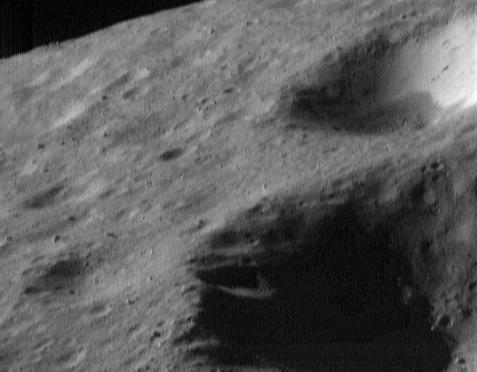
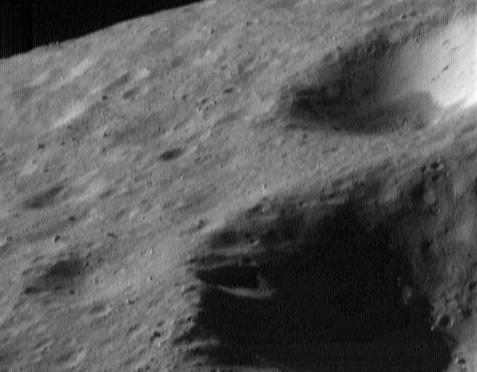
This image of Eros, taken from the NEAR Shoemaker spacecraft on May 2, 2000, from an orbital altitude of 52 kilometers (32 miles), shows a view toward Eros' horizon. The section shown is about 1.8 kilometers (1.1 miles) across. This particular view provides a snapshot of three of the most common types of features seen on the asteroid: craters whose rims have been rounded by erosion due to smaller impacts and blanketing by the impact debris, or regolith (impact debris); variations in the brightness of material on the walls of the craters; and a scattering of boulders ranging in size from nearly 100 meters (328 feet) down to about 8 meters (26 feet).
Background Info:
Built and managed by The Johns Hopkins University Applied Physics Laboratory, Laurel, Maryland, NEAR was the first spacecraft launched in NASA's Discovery Program of low-cost, small-scale planetary missions. See the NEAR web page at http://near.jhuapl.edu/ for more details.
Cataloging Keywords:
| Name | Value | Additional Values |
|---|---|---|
| Target | 433 Eros | |
| System | Near Earth Objects | |
| Target Type | Asteroid | |
| Mission | NEAR Shoemaker | |
| Instrument Host | NEAR Shoemaker | |
| Host Type | Orbiter | |
| Instrument | Multi-Spectral Imager (MSI) | |
| Detector | ||
| Extra Keywords | Crater, Grayscale, Impact | |
| Acquisition Date | ||
| Release Date | 2000-06-10 | |
| Date in Caption | 2000-05-02 | |
| Image Credit | NASA/JPL/JHUAPL | |
| Source | photojournal.jpl.nasa.gov/catalog/PIA02906 | |
| Identifier | PIA02906 | |