|
A Swath of Eros
- Click the image above for a larger view
- Full-Res JPEG (498 x 1305) (68.1 kB)
- Full-Res TIFF (498 x 1305) (471.3 kB)
Caption:
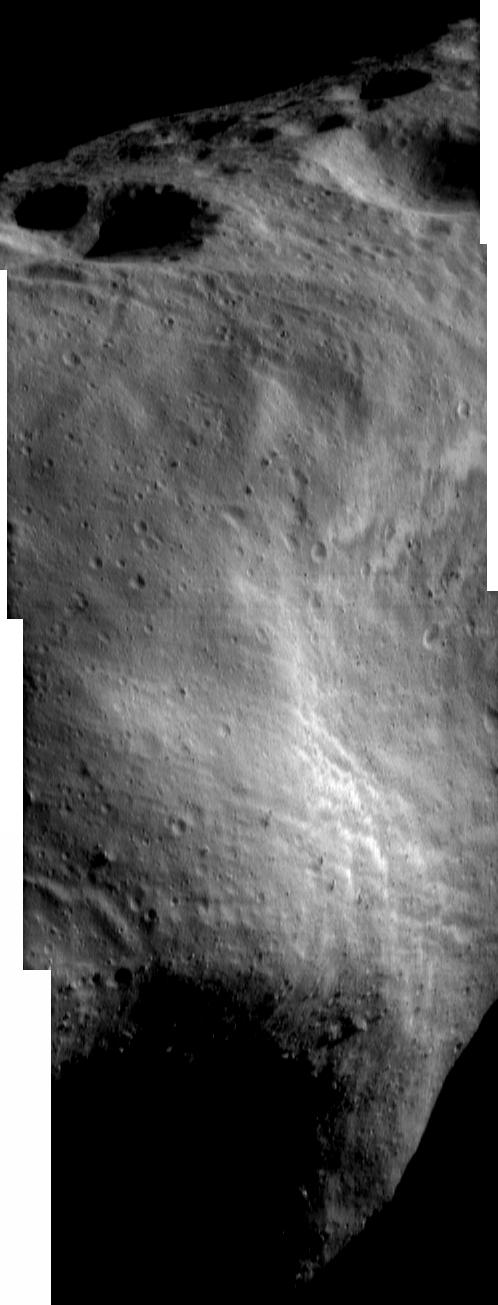
NEAR Shoemaker's scientific observations of Eros focus on different priorities as the spacecraft descends into lower orbits. For example, during the 100-kilometer (62-mile) orbit from April 11 - 22, 2000, the camera's mission was to build a global photomosaic under optimal viewing conditions. Due to the asteroid's irregular shape, doing this required imaging Eros repeatedly until each spot had been covered just right.
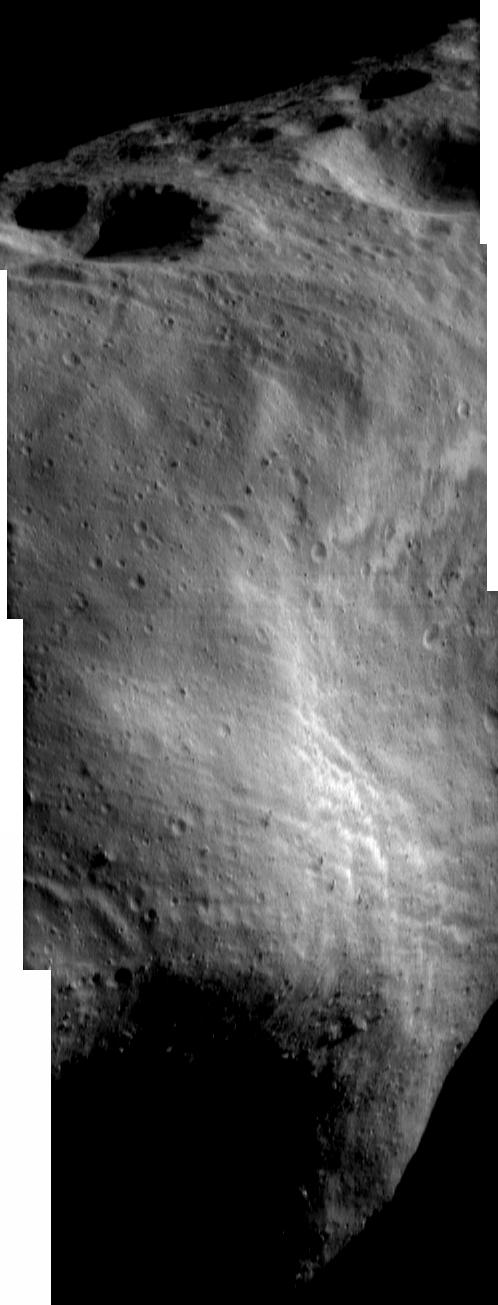
This swath of images - taken April 13 as part of that mapping campaign - shows several of the asteroid's major features. From top to bottom, these include large craters in the north polar region; part of the ridge that wraps one-third of the way around Eros; the western part of the saddle; and a dense field of enormous boulders.
Background Info:
Built and managed by The Johns Hopkins University Applied Physics Laboratory, Laurel, Maryland, NEAR was the first spacecraft launched in NASA's Discovery Program of low-cost, small-scale planetary missions. See the NEAR web page at http://near.jhuapl.edu/ for more details.
Cataloging Keywords:
| Name | Value | Additional Values |
|---|---|---|
| Target | 433 Eros | |
| System | Near Earth Objects | |
| Target Type | Asteroid | |
| Mission | NEAR Shoemaker | |
| Instrument Host | NEAR Shoemaker | |
| Host Type | Orbiter | |
| Instrument | Multi-Spectral Imager (MSI) | |
| Detector | ||
| Extra Keywords | Crater, Grayscale | |
| Acquisition Date | ||
| Release Date | 2000-06-18 | |
| Date in Caption | ||
| Image Credit | NASA/JPL/JHUAPL | |
| Source | photojournal.jpl.nasa.gov/catalog/PIA02926 | |
| Identifier | PIA02926 | |