|
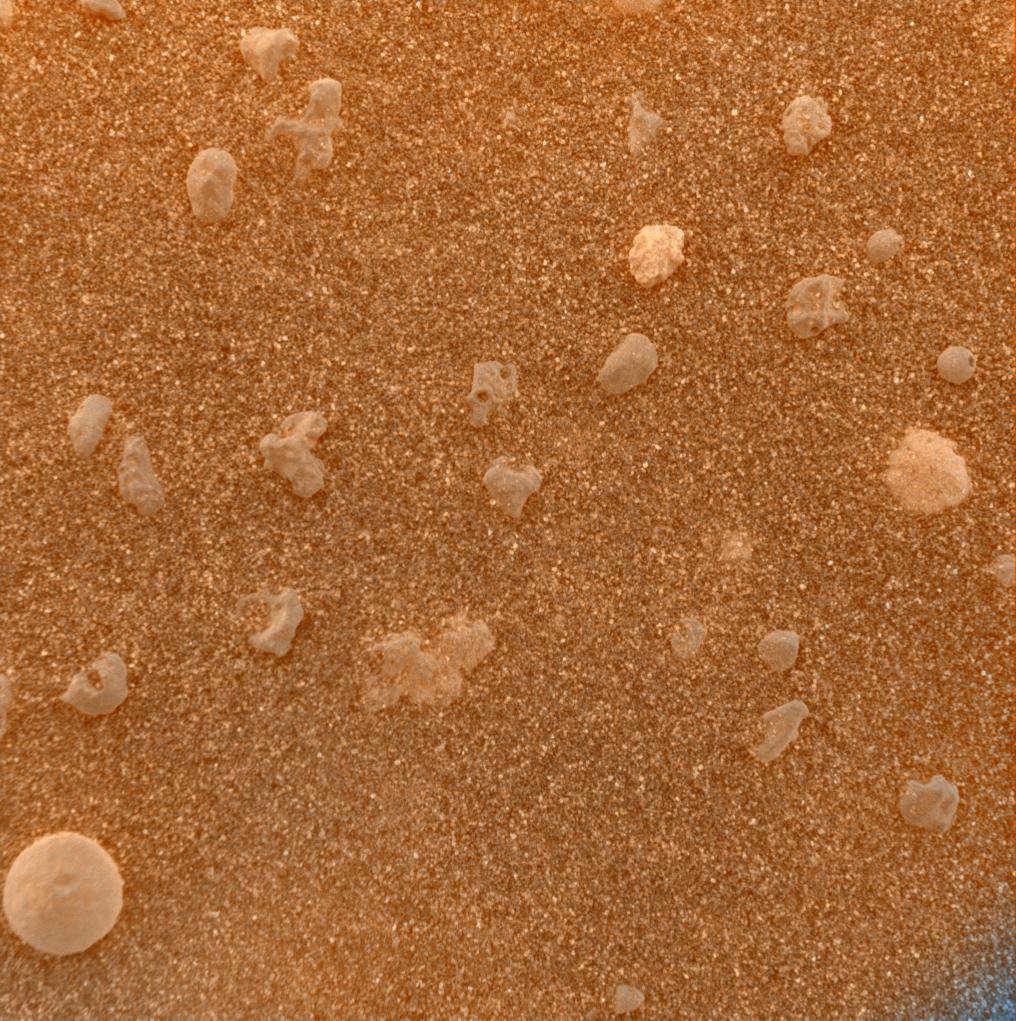
Mars Under the Microscope (color)
- Click the image above for a larger view
- Full-Res JPEG (1016 x 1021) (233.7 kB)
- Full-Res TIFF (1016 x 1021) (3.1 MB)
Caption:
This magnified look at the martian soil near the Mars Exploration Rover Opportunity's landing site, Meridiani Planum, shows coarse grains sprinkled over a fine layer of sand. The image was captured by the rover's microscopic imager on the 10th day, or sol, of its mission and roughly approximates the color a human eye would see. Scientists are intrigued by the spherical rocks, which can be formed by a variety of geologic processes, including cooling of molten lava droplets and accretion of concentric layers of material around a particle or "seed."
The examined patch of soil is 3 centimeters (1.2 inches) across. The circular grain in the lower left corner is approximately 3 millimeters (.12 inches) across, or about the size of a sunflower seed.
This color composite was obtained by merging images acquired with the orange-tinted dust cover in both its open and closed positions. The blue tint at the lower right corner is a tag used by scientists to indicate that the dust cover is closed.
Cataloging Keywords:
| Name | Value | Additional Values |
|---|---|---|
| Target | Mars | |
| System | ||
| Target Type | Planet | |
| Mission | Mars Exploration Rover (MER) | |
| Instrument Host | Opportunity (MER-B) | |
| Host Type | Rover | |
| Instrument | Microscopic Imager (MI) | |
| Detector | ||
| Extra Keywords | Color, Dust | |
| Acquisition Date | ||
| Release Date | 2004-02-04 | |
| Date in Caption | ||
| Image Credit | NASA/JPL/US Geological Survey | |
| Source | photojournal.jpl.nasa.gov/catalog/PIA05208 | |
| Identifier | PIA05208 | |