|
Planetary Building Blocks Found in Surprising Place
- Click the image above for a larger view
- Full-Res JPEG (2580 x 2010) (248.6 kB)
- Full-Res TIFF (2580 x 2010) (5.5 MB)
Caption:
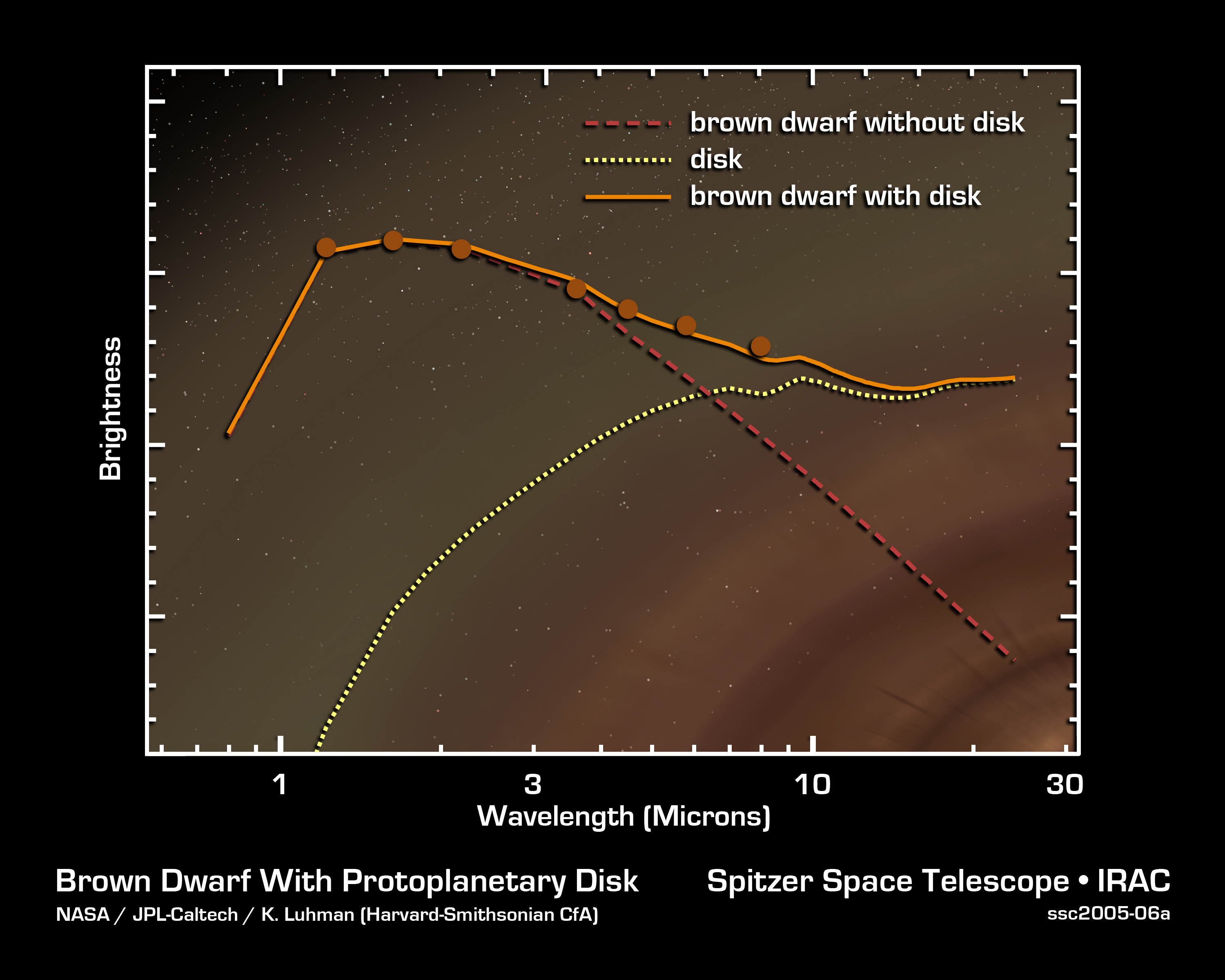
Figure 1
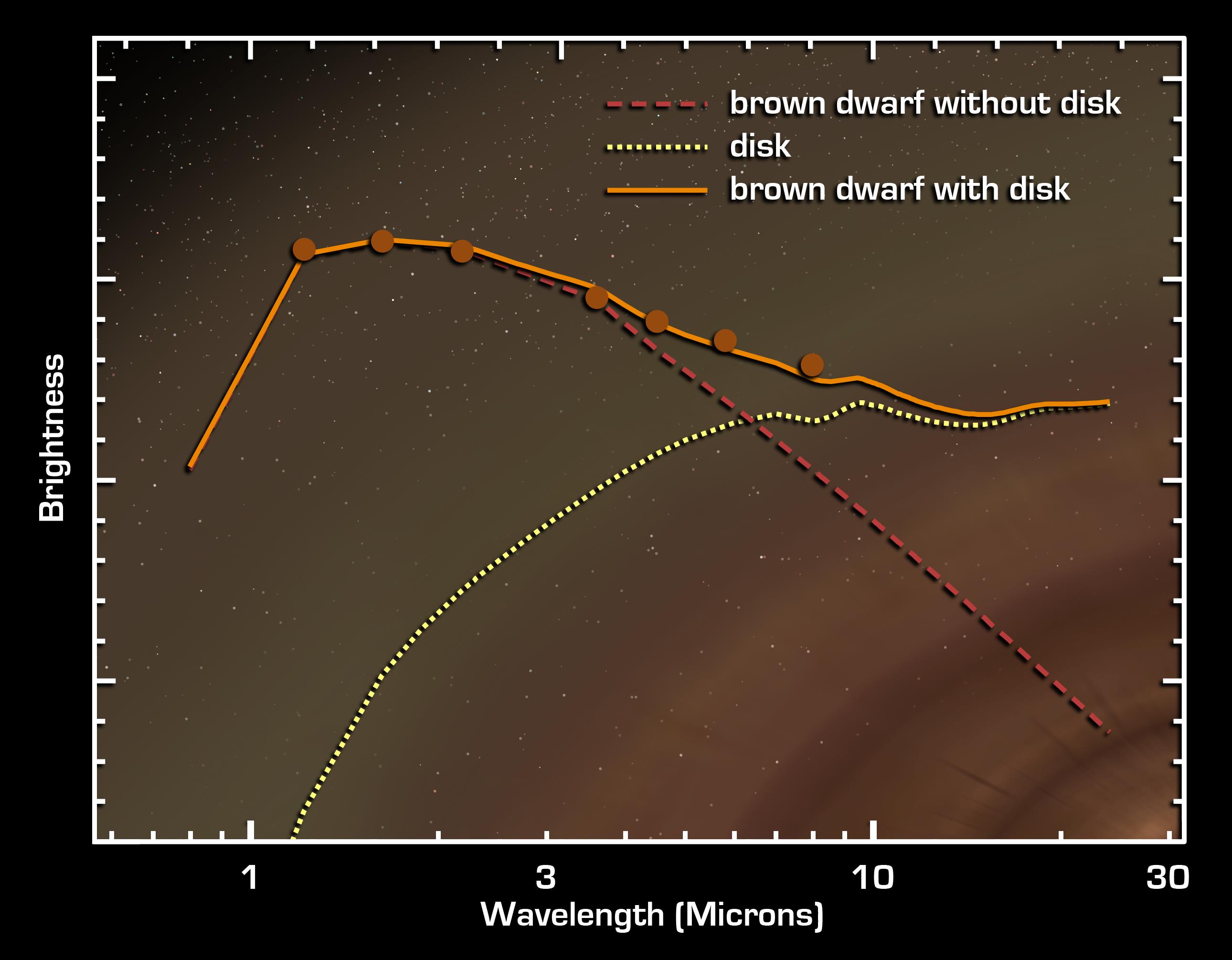
This graph of data from NASA's Spitzer Space Telescope shows that an extraordinarily low-mass brown dwarf, or "failed star," is circled by a disc of planet-building dust. The brown dwarf, called OTS 44, is only 15 times the mass of Jupiter, making it the smallest known brown dwarf to host a planet-forming disc.
Spitzer was able to see this unusual disc by measuring its infrared brightness. Whereas a brown dwarf without a disc (red dashed line) radiates infrared light at shorter wavelengths, a brown dwarf with a disc (orange line) gives off excess infrared light at longer wavelengths. This surplus light comes from the disc itself and is represented here as a yellow dotted line. Actual data points from observations of OTS 44 are indicated with orange dots. These data were acquired using Spitzer's infrared array camera.
Cataloging Keywords:
| Name | Value | Additional Values |
|---|---|---|
| Target | OTS 44 | |
| System | OTS 44 | |
| Target Type | Exoplanet | |
| Mission | Spitzer Space Telescope | |
| Instrument Host | Spitzer Space Telescope | |
| Host Type | Space Telescope | |
| Instrument | Infrared Array Camera (IRAC) | |
| Detector | ||
| Extra Keywords | Color, Dust, Infrared | |
| Acquisition Date | ||
| Release Date | 2005-02-08 | |
| Date in Caption | ||
| Image Credit | NASA/JPL-Caltech/Harvard-Smithsonian CfA | |
| Source | photojournal.jpl.nasa.gov/catalog/PIA07337 | |
| Identifier | PIA07337 | |