|
Water Abundances Change with Time of Day
- Click the image above for a larger view
- Full-Res JPEG (1000 x 750) (86.1 kB)
- Full-Res TIFF (1000 x 750) (2.3 MB)
Caption:
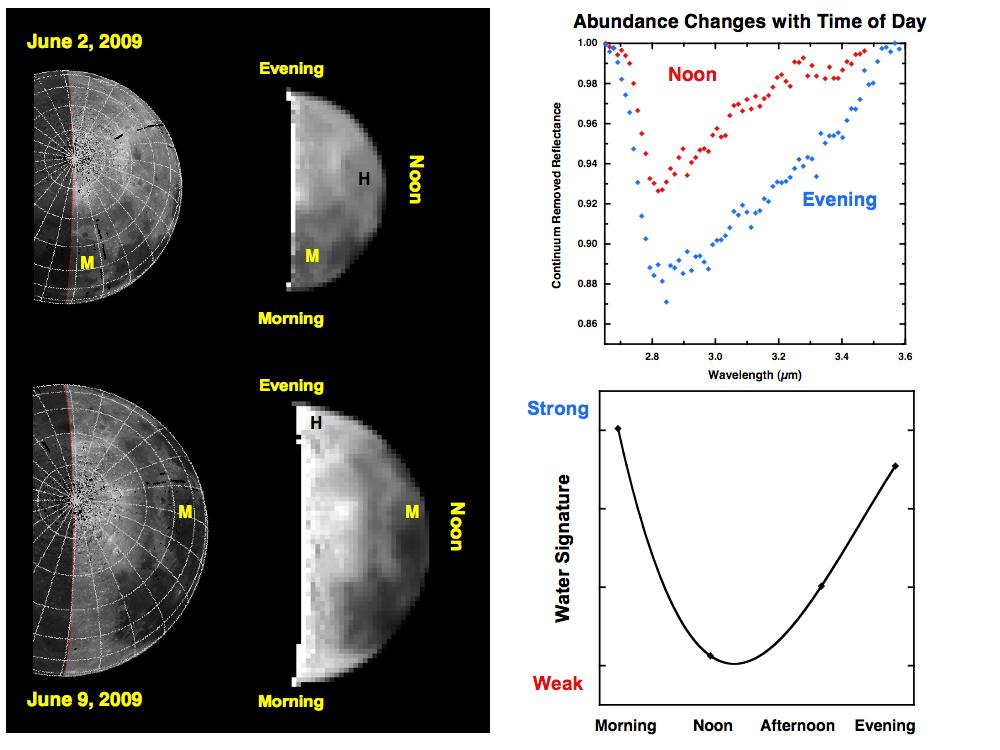
Observations from NASA's Deep Impact mission of the moon's north pole from June 2 to 9, 2009 reveal changes in the amounts of water and hydroxyl. In the week between these datasets, the moon had rotated 90 degrees (one-quarter of a lunar day). For example, a volcanic mare terrain (labeled 'M') is observed in the morning on June 2, but by June 9 is at local noon. Similarly, a highland unit ('H') begins at noon and rotates to evening on June 9.
Deep Impact observed a significant change in the strength of a water and hydroxyl signature as the moon rotated around. The highland unit, for example, has a weaker signal near noon (red) and a stronger signal by evening (blue). Taken together, the data show a systematic change in water loss from morning to noon, recovery through the afternoon, and a return to a steady state by evening. This daytime cycle suggests that hydrogen ions in the solar wind may be a source for re-hydration.
Cataloging Keywords:
| Name | Value | Additional Values |
|---|---|---|
| Target | Moon | 9P/Tempel |
| System | Earth | Periodic Comets |
| Target Type | Satellite | Comet |
| Mission | Deep Impact | |
| Instrument Host | Deep Impact | |
| Host Type | Impactor | |
| Instrument | ||
| Detector | ||
| Extra Keywords | Color, Impact, Rotation, Volcano, Water | |
| Acquisition Date | ||
| Release Date | 2009-09-24 | |
| Date in Caption | ||
| Image Credit | NASA/JPL-Caltech/University of Maryland | |
| Source | photojournal.jpl.nasa.gov/catalog/PIA12222 | |
| Identifier | PIA12222 | |