|
Magnetic Fields and Bow Shocks (Illustration)
- Click the image above for a larger view
- Full-Res JPEG (1280 x 1440) (168.2 kB)
- Full-Res TIFF (1280 x 1440) (5.5 MB)
Caption:
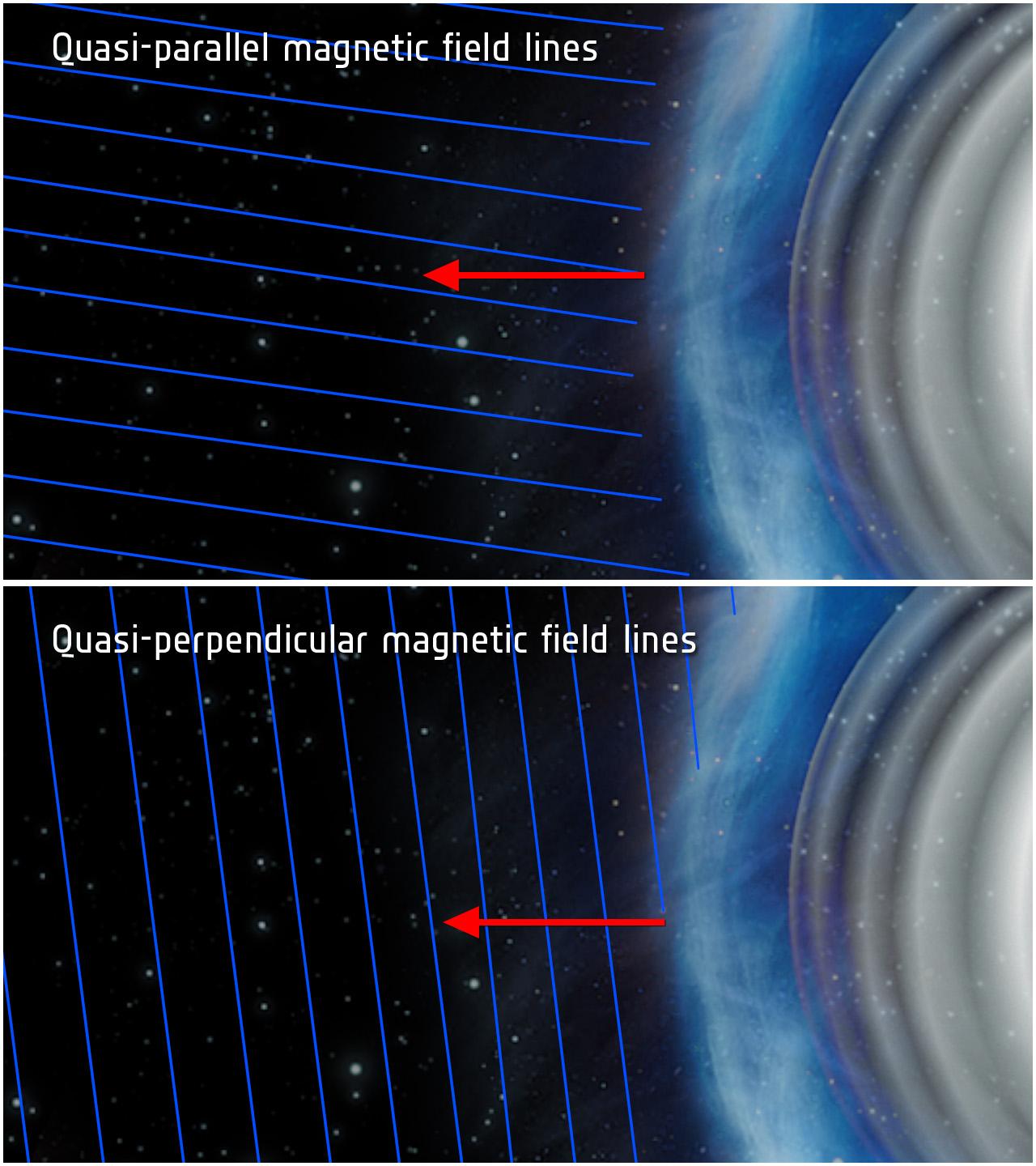
This illustration shows "quasi-parallel" (top) and "quasi-perpendicular" (bottom) magnetic field conditions at a planetary bow shock. Bow shocks are shockwaves created when the solar wind blows on a planet's magnetic field.
Under quasi-parallel conditions, the planet's magnetic field is roughly pointing toward the shock surface, almost parallel to a vector at right angles to the shock front (red arrow). Under quasi-perpendicular conditions, the magnetic field is close to aligned with the shock surface, that is, almost perpendicular to the shock vector.
Background Info:
The Cassini-Huygens mission is a cooperative project of NASA, the European Space Agency and the Italian Space Agency. JPL manages the mission for NASA's Science Mission Directorate, Washington. JPL is a division of the California Institute of Technology, Pasadena.
For more information about the Cassini-Huygens mission, visit http://www.nasa.gov/cassini and http://saturn.jpl.nasa.gov/ .
Cataloging Keywords:
| Name | Value | Additional Values |
|---|---|---|
| Target | Saturn | |
| System | ||
| Target Type | Planet | |
| Mission | Cassini-Huygens | |
| Instrument Host | Cassini Orbiter | |
| Host Type | Orbiter | |
| Instrument | ||
| Detector | ||
| Extra Keywords | Color, Magnetosphere | |
| Acquisition Date | ||
| Release Date | 2013-02-19 | |
| Date in Caption | ||
| Image Credit | ESA | |
| Source | photojournal.jpl.nasa.gov/catalog/PIA16825 | |
| Identifier | PIA16825 | |