|
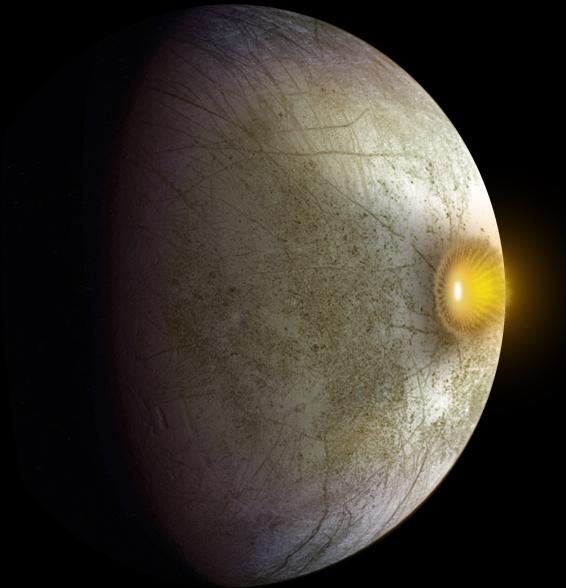
Hit Hard: Possible Collision at Europa (Artist’s Concept)
- Click the image above for a larger view
- Full-Res JPEG (2208 x 2292) (338.3 kB)
- Full-Res TIFF (2208 x 2292) (15.2 MB)
Caption:
This artist's concept shows a possible explosion resulting from a high-speed collision between a space rock and Jupiter's moon Europa. Clay-type minerals have been found on Europa's surface in a new analysis of data from NASA's Galileo mission. The pattern of these minerals suggests an asteroid about 3,600 feet (1,100 meters) across or a comet about 5,600 feet (1,700 meters) across could have hit at a shallow angle. Clay-type minerals are commonly found in primitive asteroids and some comets. These kinds of asteroids and comets also typically carry organic compounds, providing a possible way for organics to be delivered to Europa.
Background Info:
For more information about Europa, visit: http://solarsystem.nasa.gov/europa/home.cfm .
JPL is a division of the California Institute of Technology in Pasadena.
Cataloging Keywords:
| Name | Value | Additional Values |
|---|---|---|
| Target | Europa | |
| System | Jupiter | |
| Target Type | Satellite | |
| Mission | Galileo | |
| Instrument Host | Galileo Orbiter | |
| Host Type | Orbiter | |
| Instrument | ||
| Detector | ||
| Extra Keywords | Artwork, Asteroid, Collision, Color, Comet | |
| Acquisition Date | ||
| Release Date | 2013-12-11 | |
| Date in Caption | ||
| Image Credit | NASA/JPL-Caltech | |
| Source | photojournal.jpl.nasa.gov/catalog/PIA17657 | |
| Identifier | PIA17657 | |

