|
Asteroid 2014 DX110 Flyby of Earth on March 5, 2014
- Click the image above for a larger view
- Full-Res JPEG (1024 x 768) (37.5 kB)
- Full-Res TIFF (1024 x 768) (2.4 MB)
Caption:
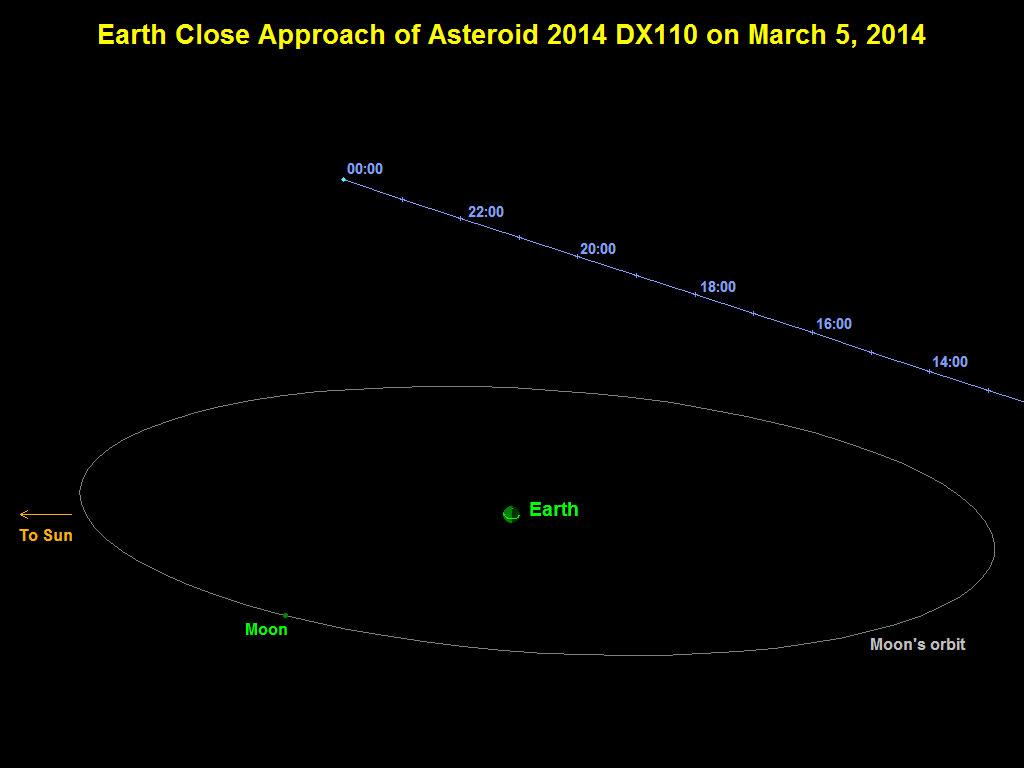
This graphic depicts the passage of asteroid 2014 DX110 past Earth on March 5, 2014. The asteroid's closest approach was at a distance equivalent to about nine-tenths of the distance between Earth and the moon. Times indicated on the graphic are Universal Time. A time near closest approach, 2200 Universal Time, is 2 p.m. PST.
Background Info:
NASA detects, tracks and characterizes asteroids and comets using both ground- and space-based telescopes. The Near-Earth Object Observations Program, commonly called "Spaceguard," discovers these objects, characterizes a subset of them and identifies their close approaches to determine if any could be potentially hazardous to our planet.
NASA's Jet Propulsion Laboratory, Pasadena, Calif., manages the Near-Earth Object Program Office for NASA's Science Mission Directorate in Washington. JPL is a division of the California Institute of Technology in Pasadena.
More information about asteroids and near-Earth objects is at http://www.jpl.nasa.gov/asteroidwatch .
Cataloging Keywords:
| Name | Value | Additional Values |
|---|---|---|
| Target | 2014 DX110 | |
| System | Near Earth Objects | |
| Target Type | Asteroid | |
| Mission | ||
| Instrument Host | ||
| Host Type | ||
| Instrument | ||
| Detector | ||
| Extra Keywords | Color | |
| Acquisition Date | ||
| Release Date | 2014-03-05 | |
| Date in Caption | 2014-03-05 | |
| Image Credit | NASA/JPL-Caltech | |
| Source | photojournal.jpl.nasa.gov/catalog/PIA17955 | |
| Identifier | PIA17955 | |