|
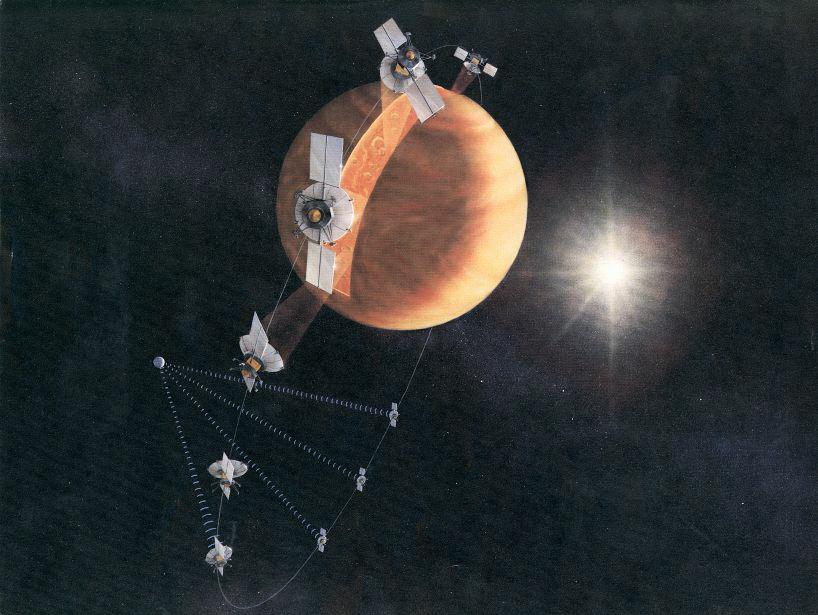
Magellan Orbit (Artist’s Concept)
- Click the image above for a larger view
- Full-Res JPEG (818 x 615) (84.0 kB)
- Full-Res TIFF (818 x 615) (1.5 MB)
Caption:
An artist's concept of the Magellan spacecraft making a radar map of Venus.
Magellan mapped 98 percent of Venus' surface at a resolution of 100 to 150 meters (about the length of a football or soccer field), using synthetic aperture radar, a technique that simulates the use of a much larger radar antenna. It found that 85 percent of the surface is covered with volcanic flows and showed evidence of tectonic movement, turbulent surface winds, lava channels and pancake-shaped domes. Magellan also produced high-resolution gravity data for 95 percent of the planet and tested a new maneuvering technique called aerobraking, using atmospheric drag to adjust its orbit.
The spacecraft was commanded to plunge into Venus' atmosphere in 1994 as part of a final experiment to gather atmospheric data.
Cataloging Keywords:
| Name | Value | Additional Values |
|---|---|---|
| Target | Venus | |
| System | ||
| Target Type | Planet | |
| Mission | Magellan | |
| Instrument Host | Magellan | |
| Host Type | Orbiter | |
| Instrument | ||
| Detector | ||
| Extra Keywords | Artwork, Atmosphere, Color, Map, Radar, Volcano | |
| Acquisition Date | ||
| Release Date | 1990-08-10 | |
| Date in Caption | ||
| Image Credit | NASA/JPL-Caltech | |
| Source | photojournal.jpl.nasa.gov/catalog/PIA18175 | |
| Identifier | PIA18175 | |