|
Gullies and Bedrock in Nirgal Vallis
- Click the image above for a larger view
- Full-Res JPEG (2880 x 1800) (1.1 MB)
- Full-Res TIFF (2880 x 1800) (15.6 MB)
Caption:

Map Projected Browse Image
Click on the image for larger version
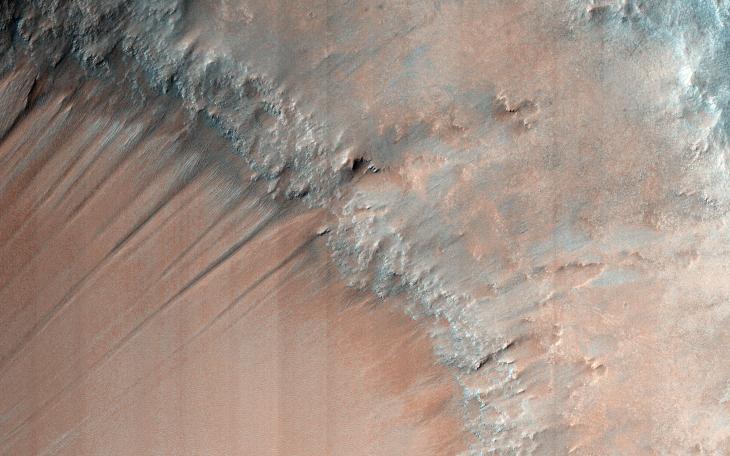
The gullies in this image are within the valley wall of an ancient channel-Nirgal Vallis-a testament to flowing water in Mars' ancient past. However, the formation of gullies are still the subject of much debate with respect to their formation: "wet" vs. "dry" or even "dry" with the aid of some lubricating fluid.
Gullies most commonly form in the steep walls of simple craters . Gullies are common even in cold arctic deserts on Earth (e.g., the Haughton impact structure on Devon Island). This suggests that these provocative features can form on a mostly dry Mars that is only sporadically wet.
Regardless, these features bear a remarkable resemblance to flowers, including the blossom, petals, stem, and roots. Can you see it too?
Background Info:
The University of Arizona, Tucson, operates HiRISE, which was built by Ball Aerospace & Technologies Corp., Boulder, Colo. NASA's Jet Propulsion Laboratory, a division of the California Institute of Technology in Pasadena, manages the Mars Reconnaissance Orbiter Project for NASA's Science Mission Directorate, Washington.
Cataloging Keywords:
| Name | Value | Additional Values |
|---|---|---|
| Target | Mars | |
| System | ||
| Target Type | Planet | |
| Mission | Mars Reconnaissance Orbiter (MRO) | |
| Instrument Host | Mars Reconnaissance Orbiter | |
| Host Type | Orbiter | |
| Instrument | High Resolution Imaging Science Experiment (HiRISE) | |
| Detector | ||
| Extra Keywords | Color, Crater, Impact, Map, Water | |
| Acquisition Date | ||
| Release Date | 2015-02-11 | |
| Date in Caption | ||
| Image Credit | NASA/JPL-Caltech/University of Arizona | |
| Source | photojournal.jpl.nasa.gov/catalog/PIA19294 | |
| Identifier | PIA19294 | |