|
Southern Winter Frost Accumulations
- Click the image above for a larger view
- Full-Res JPEG (2880 x 1800) (546.5 kB)
- Full-Res TIFF (2880 x 1800) (15.4 MB)
Caption:
Map Projected Browse Image
Click on the image for larger version
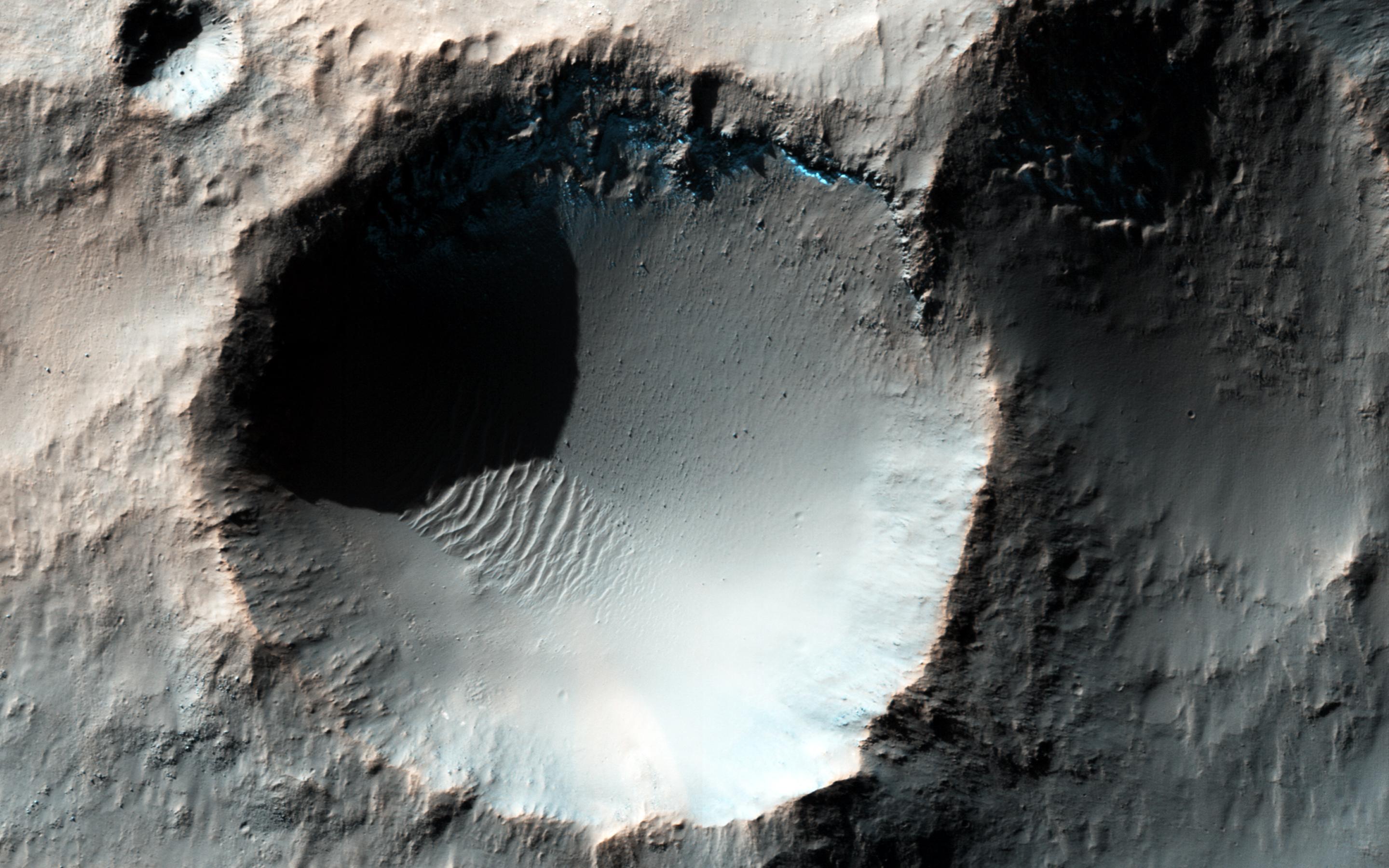
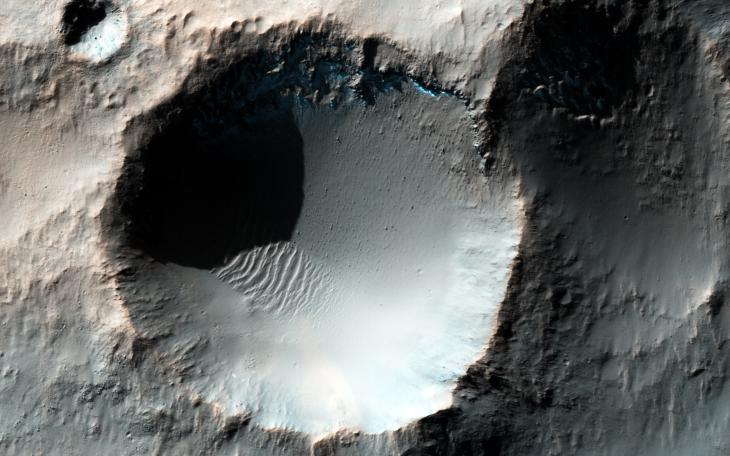
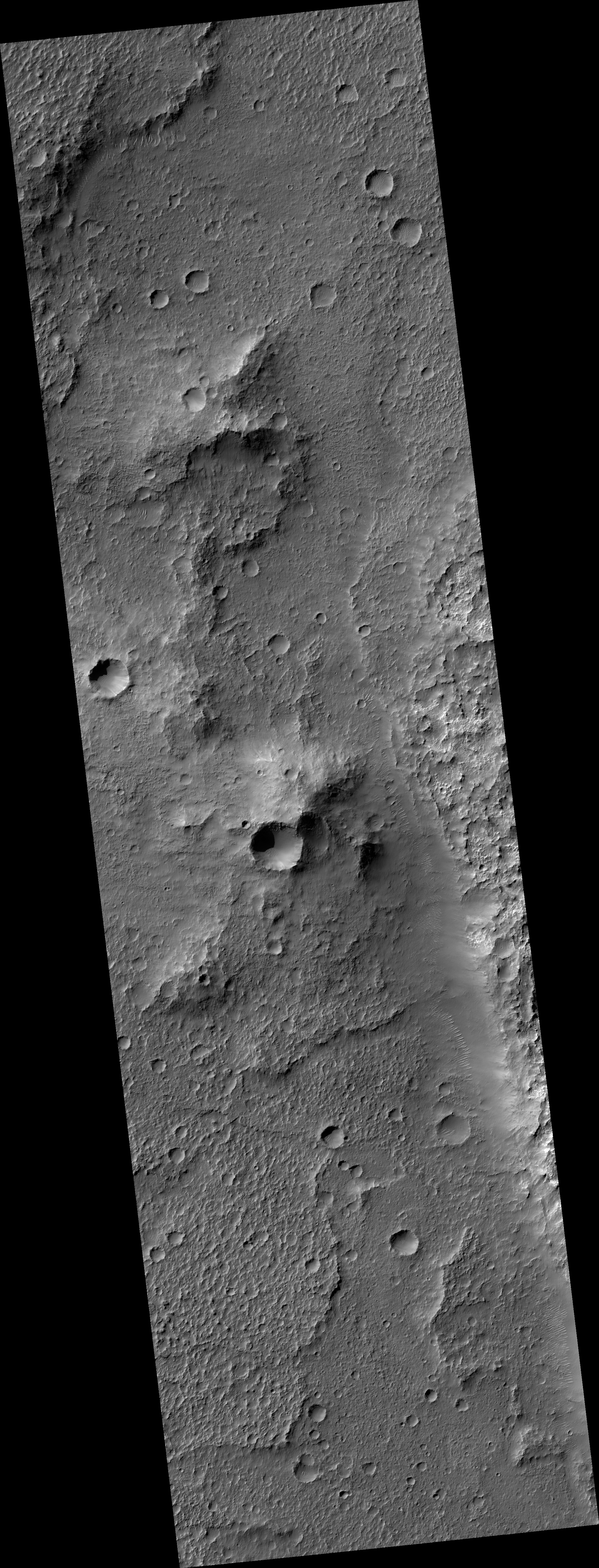
This enhanced color HiRISE image shows several craters somewhere in the southern mid-latitudes of Mars. It is currently mid-winter in the Southern hemisphere, so we can observe accumulating frost (neon blues) on pole-facing slopes (i.e. south-facing) and in shadowed areas .
However, the bluish deposits and ejecta deposits associated with the smaller crater we see are not consistent with frost deposits. These materials are most likely iron-bearing minerals that have not been previously oxidized (i.e., rusted), and have only recently been exposed to the surface when this small well-preserved crater was formed.reviously oxidized (i.e., rusted), and have only recently been exposed to the surface when this small well-preserved crater was formed.
Background Info:
The University of Arizona, Tucson, operates HiRISE, which was built by Ball Aerospace & Technologies Corp., Boulder, Colo. NASA's Jet Propulsion Laboratory, a division of the California Institute of Technology in Pasadena, manages the Mars Reconnaissance Orbiter Project for NASA's Science Mission Directorate, Washington.
Cataloging Keywords:
| Name | Value | Additional Values |
|---|---|---|
| Target | Mars | |
| System | ||
| Target Type | Planet | |
| Mission | Mars Reconnaissance Orbiter (MRO) | |
| Instrument Host | Mars Reconnaissance Orbiter | |
| Host Type | Orbiter | |
| Instrument | High Resolution Imaging Science Experiment (HiRISE) | |
| Detector | ||
| Extra Keywords | Color, Crater, Map, Shadow | |
| Acquisition Date | ||
| Release Date | 2016-05-04 | |
| Date in Caption | ||
| Image Credit | NASA/JPL-Caltech/Univ. of Arizona | |
| Source | photojournal.jpl.nasa.gov/catalog/PIA20661 | |
| Identifier | PIA20661 | |